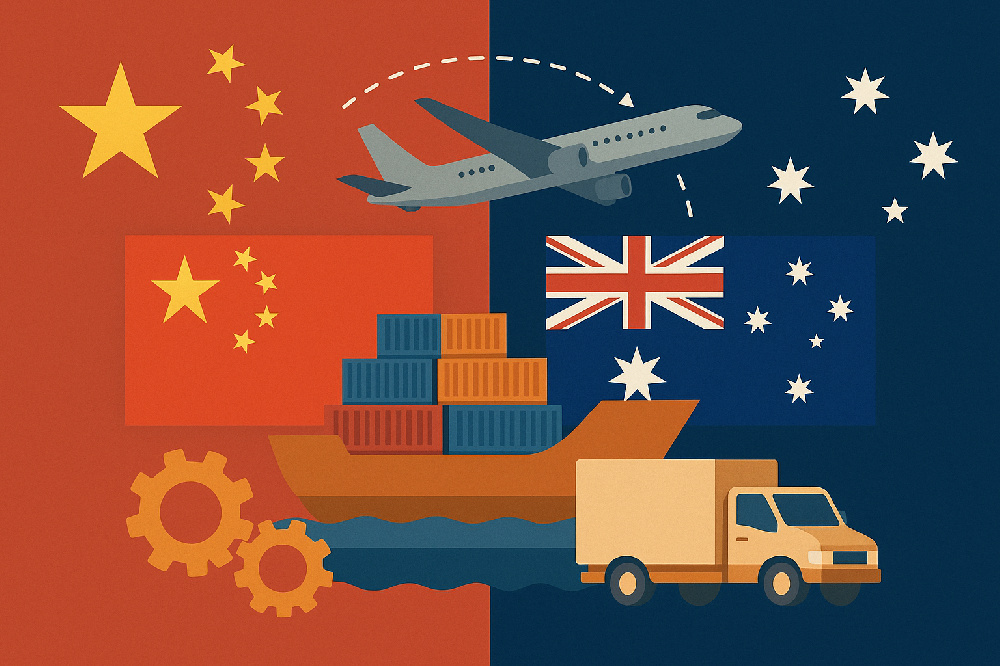
Robust Bilateral Trade Lays the Foundation for Logistics
China and Australia maintain a highly complementary trade relationship. China has been Australia's largest trading partner, accounting for approximately 27% of Australia's total goods and services trade in 2023.
With improving diplomatic ties, bilateral trade continues to rise. In 2023, China–Australia trade increased by 9.2% year-on-year, reaching AUD 326.9 billion (USD 215.78 billion). This strong trade volume provides a solid foundation for the freight forwarding market and drives substantial cargo movement between the two nations.
Currently, China mainly exports manufactured goods such as machinery, transport equipment, and furniture to Australia, while Australia exports bulk commodities like iron ore and energy products to China. This means freight forwarders play a key role in handling both containerized imports and bulk exports.
Market Size Continues to Expand
Driven by trade growth, the logistics market between China and Australia has expanded steadily. In 2024, the Australian freight forwarding market is projected to reach USD 13.81 billion and is expected to grow to USD 18.65 billion by 2029, at a CAGR of approximately 6.23%.
Port data confirms this trend: in the first three quarters of 2023, Australia's major ports handled about 8.9 million TEUs, a 7.2% increase year-on-year. Cargo volume along the China–Australia route accounts for roughly 42% of Australia's total international trade routes, making it the largest by volume. This strong demand has attracted both global freight forwarding giants such as DSV and Kuehne+Nagel and local Australian logistics providers, intensifying competition and pushing firms to improve service quality and operational efficiency.
Key Industry Trends
1. Cross-border E-commerce Surge
Cross-border e-commerce has emerged as a major growth engine for China–Australia logistics. The share of e-commerce parcels in bilateral freight rose from 15% in 2020 to 28% in 2023. Australia's cross-border e-commerce market is expected to reach AUD 72 billion in 2024. In response, freight forwarders are launching dedicated e-commerce shipping lanes and overseas warehouse services. The "overseas warehouse + last-mile delivery" model can reduce distribution costs by about 30%.
2. Customs Efficiency Improvements
Since December 2023, China and Australia have recognized each other's Authorized Economic Operator (AEO) programs, offering certified businesses streamlined customs clearance, lower inspection rates, and priority handling. This move is expected to reduce clearance time and logistics costs. In addition, China has lifted import restrictions on Australian goods like wine and barley, further improving the customs environment.
3. Transportation Modal Shift and Digitalization
Maritime shipping remains dominant, accounting for over 80% of bilateral freight volume. While air freight has rebounded post-pandemic, high costs (USD 6.5–10.5 per kg) limit its use to time-sensitive goods. To meet diverse customer needs, freight forwarders now offer full-container load (FCL), less-than-container load (LCL), and multi-modal transport services. Meanwhile, digital transformation is advancing rapidly — from online booking and real-time tracking to smart warehousing and blockchain-based e-bills of lading.
4. Rise of Green Logistics
Under the global push for carbon neutrality, China–Australia logistics is embracing sustainable practices. Notably, China COSCO Shipping and Australia's Fortescue Metals have signed an agreement to develop a green ammonia-fueled shipping supply chain for transporting iron ore, marking a step toward a "green shipping corridor."
Future Opportunities
Booming e-commerce will continue to create new logistics demand, especially for small parcels and warehousing solutions.
Improved bilateral relations and trade agreements such as ChAFTA and RCEP will reduce tariffs and simplify customs procedures.
Technological advancement through smart systems, AI route optimization, and blockchain document management offers efficiency gains.
Sustainable supply chains are becoming a market differentiator for companies that invest early in green logistics.
In summary, the continued growth of bilateral trade, emergence of new logistics models, and favorable policy environment are powering the next phase of China–Australia freight forwarding development.