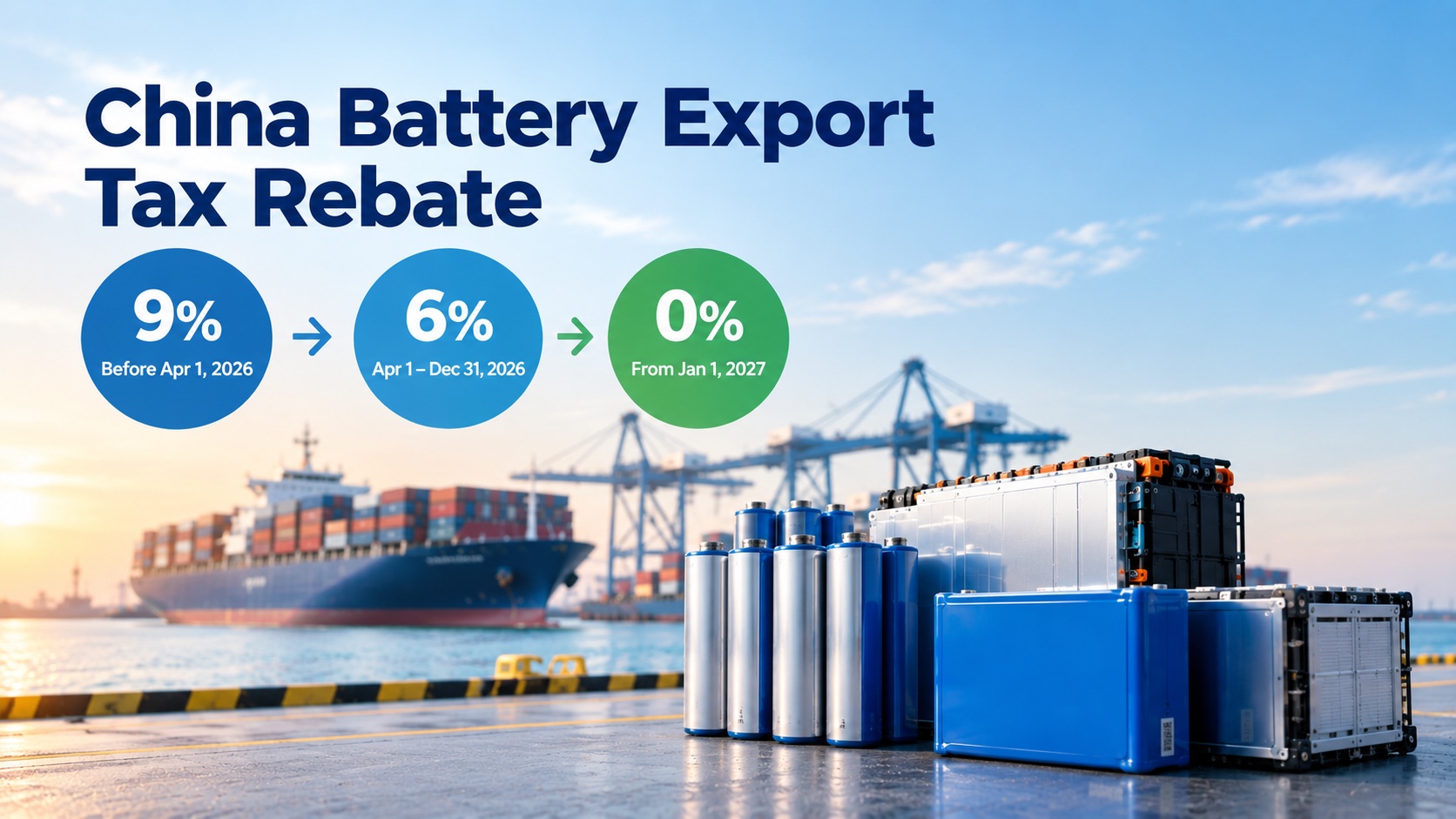
China has introduced changes to the export VAT rebate policy for battery products, including lithium-ion batteries. For overseas companies sourcing batteries and energy storage products from China, this policy change may have an impact on supplier pricing and future procurement costs.
Under the new policy, the export VAT rebate rate for relevant battery products will be adjusted in stages:
Lithium-ion rechargeable batteries classified under HS Code 85076000 are among the products affected by the adjustment.
In simple terms, the export VAT rebate available to eligible Chinese exporters is being reduced from 9% to 6% in 2026 and will be eliminated from 2027.
The export VAT rebate is a tax mechanism for eligible Chinese exporters. It is not a tax directly charged to overseas buyers and does not mean that an importer will suddenly have to pay an additional 9% or 6% tax when importing the product.
However, the policy can affect the economics of exporting from China.
Chinese manufacturers and exporters previously able to obtain a higher export VAT rebate may now recover less of their input VAT through the export process. Depending on their cost structure and profit margin, suppliers may therefore need to adjust their export prices.
For example, if a supplier previously built its quotation around a certain level of tax rebate, a reduction in the rebate may reduce its net margin. The supplier could respond by:
The actual impact will vary from supplier to supplier.
Not necessarily.
This is an important point for international buyers.
A reduction in the export VAT rebate from 9% to 6% does not mean that the supplier's quotation will automatically increase by 3%.
The actual financial impact depends on several factors, including the supplier's purchase costs, input VAT, production costs, existing profit margin, export pricing strategy and tax position.
Therefore, buyers should avoid simply adding 3% or 6% to an existing quotation when estimating the impact of the policy.
Instead, it is better to ask the supplier whether the new rebate rate has already been incorporated into the quotation.
The policy is particularly relevant to companies involved in the international trade of:
However, the exact tax treatment depends on the specific product and HS classification.
This is particularly important for energy storage products because a complete energy storage system may contain multiple components, including battery cells, battery modules, a battery management system, power conversion equipment and other electrical components.
Therefore, importers should not assume that all products described commercially as "energy storage systems" are subject to exactly the same tax treatment as individual lithium-ion batteries.
For companies purchasing batteries from China, it is advisable to discuss the policy directly with suppliers before confirming long-term pricing.
Buyers may want to ask:
These questions can help buyers distinguish between a genuine policy-related cost increase and a normal commercial price adjustment.
For shipments that are already being prepared or are under existing contracts, buyers should confirm the applicable pricing and tax arrangements with their Chinese supplier.
The key issue is not simply when an order was placed, but how the relevant Chinese tax and export regulations apply to the specific transaction.
For large-volume or long-term procurement, it may also be useful to include a clear mechanism in the commercial agreement covering future changes in Chinese tax policy.
The most significant change will come on January 1, 2027, when the export VAT rebate for the affected battery products is scheduled to be eliminated.
For overseas buyers with significant sourcing volumes from China, this makes 2026 an important period for reviewing procurement strategies and supplier quotations.
However, the elimination of the rebate does not automatically mean that Chinese battery prices will rise by the same percentage. Market competition, raw-material prices, manufacturing costs, exchange rates and supplier margins will continue to influence the final export price.
China's adjustment of the battery export VAT rebate is an important change for the international battery and energy storage supply chain.
For overseas importers, the key takeaway is simple:
The policy does not directly impose a new tax on foreign buyers, but it may increase the cost pressure faced by Chinese exporters and could therefore influence future supplier quotations.
Importers purchasing lithium batteries or energy storage products from China should therefore review their HS classifications, existing quotations and long-term supply agreements, and communicate with suppliers about how the policy change will affect future pricing.
Early communication with suppliers can help buyers better understand the actual cost impact and avoid unexpected price adjustments during 2026 and beyond.
Related reading: our battery shipping service, lithium battery export shipping insights, and the glossary entries for UN38.3 Report and MSDS.